It's Friday night. You're staring at the schedule.
Monday is a road game against a team that almost beat you last year. You have a feeling about what to do. Switch the screens. Push the pace. Let the bigs roam off their guards' weak side.
But you've coached long enough to know your feeling has been wrong before. Last season you went in convinced you'd press them off the floor. Six minutes in, you saw it wasn't working - and by the time you adjusted, it was a 14-point game.
The hard part about building a game plan isn't picking a style. It's picking the right one for this roster against that opponent, when you're holding maybe 40% of the information you'd need to be sure.
This is the post about that.
The data coaches actually miss
Every coach has the same problem: not enough hours in the week, way too much data, and the parts of that data that matter most are the parts that don't fit on one printout.
Here's what most coaches can't track in a normal week - not because they're not smart enough, but because there isn't time:
- Lineup combinations. Which 5-man unit on your team actually has the best plus/minus? The starters? The "energy" unit with Player 6 in for Player 1? You probably know the vibes of each lineup. The numbers tell you something different.
- Style fit with personnel. Does your roster actually match the pace-and-space identity you've been pushing? Or are your three best players guys who get fouled on post-ups and don't shoot threes well?
- Bench fatigue patterns. When in the season did your bench start playing tight? Was it the third week of December? Was it after the 4-games-in-9-days stretch? You can feel it. You can't quantify it.
- Matchup-specific tendencies. "We shoot 8% worse on Tuesday games after a Saturday road trip." Most coaches I know don't know this - because tracking it would require pulling four different spreadsheets.
- Opponent tendencies vs your strengths. Their offense averages 1.04 points per possession against teams that hedge ball screens. You hedge ball screens. That should change your game plan. Did anyone tell you?
This isn't an "AI is smarter than coaches" argument. It's not. AI just has the time to look at all of the data at once - which is the part of the job that doesn't scale by trying harder.
Picking a style that fits this roster - the Tactician's job
Here's the move I see good coaches make that bad coaches don't: they pick a style for the team they have, not the team they wish they had.
This sounds obvious. It isn't. Most game plans are slight variations on whatever the coach learned to coach years ago. If you grew up running motion offense in college, you tend to coach motion offense - even when your roster has two athletic wings, a stretch-five, and zero passers.
AI tools that are built for this part of the job - the strategy part - work differently than the AI you've seen for stat-sheet summaries. They take the roster: heights, ages, levels, skill ratings, conditioning notes, what each kid did well last season. Then they take performance to date: what's actually working, what isn't, where you're scoring, where you're getting scored on. And they produce a recommendation tied to your specific personnel:
"Your two best perimeter defenders are also your two best transition scorers. Your bigs aren't great post finishers but they screen well in space. The data and the roster both point at pace-and-space with an emphasis on early-clock looks off rebounds. The tradeoff is your two starting bigs each lose 4-6 minutes a game in this style - you'd want to talk to them before installing it."
Notice what that's doing. It's not telling you what to do. It's telling you what fits, what doesn't, and what the cost is. The decision - whether you're willing to bench a senior big for 6 fewer minutes a night - is still yours. The data work that informs the decision is the part that got fast.
What AI gets right here: it doesn't fall in love with a system. It doesn't have an ego. It optimizes for the roster, not for the playbook you'd love to run.
What AI gets wrong: it doesn't know the kid you can't bench because his dad is the booster club president. It doesn't know that the parent group has been pushing you to play "more team basketball." It doesn't know that two of your starters had a fight last weekend.
So you take the recommendation seriously, you cross-check it against the things only you know, and you make the call.
NextPlay's Tactician is built around exactly this loop. It pulls the roster, the season data, and what you know about each kid, and proposes a style of play that fits the personnel - with the tradeoffs spelled out. Most head coaches I've talked to spend Sunday afternoons doing this work in their head. The Tactician does the data work so you can spend that hour on the decisions only you can make.
Translating strategy into the practice plan - Coach Duncan's job
This is the part where most game plans die.
Every coach reading this has done it: you spend an hour on Friday night deciding "we need to play faster." Then Monday's practice rolls around and you run the same practice you ran last week - three skill drills, a half-court 5-on-5, and a scrimmage. Tuesday, same thing. Thursday, same. You've decided to play faster, but nothing in your practice routine forces the team to actually become a faster team.
Strategy without practice translation is just a thought you had in the parking lot after a game.
The harder skill is this: given a strategic direction, what do you DO in practice for the next 4 weeks to get there? Most coaches I know - including good ones - guess. They drill what they always drill. They run the drills they enjoyed running. They almost never sit down and say, "If I want this team to play pace-and-space by Christmas, here's the practice progression that gets us there."
This is where the second AI specialist shows up. Where the Tactician's job ends at "here's the style," the next specialist's job starts at "here's a 4-week practice program that builds toward that style." Specifically:
- Drill selection - pulls drills that actually develop the style (early-clock decision-making, transition spacing, off-ball movement, defensive rebounding outlet reads).
- Sequencing across the program - Week 1 looks different from Week 4. Week 1 builds the basics; Week 4 puts them under pressure.
- Time allocation - if you only have 75 minutes per practice, what percentage goes to the new identity versus the things you still need to maintain?
- Reality check - if your team can't yet make the basic passes a pace-and-space offense requires, the AI won't pretend they can. It'll back the plan up by two weeks and put the basics first.
The output isn't a script. It's a working plan you adjust. You'll cut drills you don't believe in. You'll add ones the AI didn't think of. You'll change the order based on what happened in Monday's practice. The point isn't that the AI builds your practices for you - the point is that it gives you a starting framework that's actually tied to the strategy, instead of you starting from a blank page at 9 PM on Sunday.
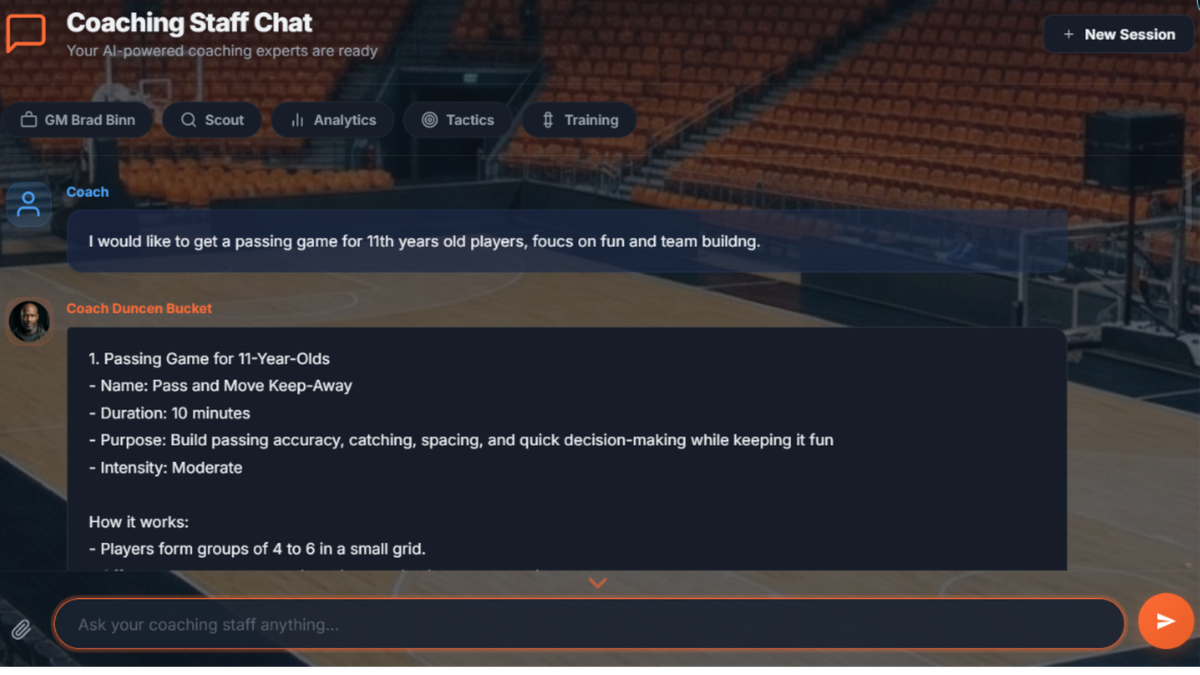
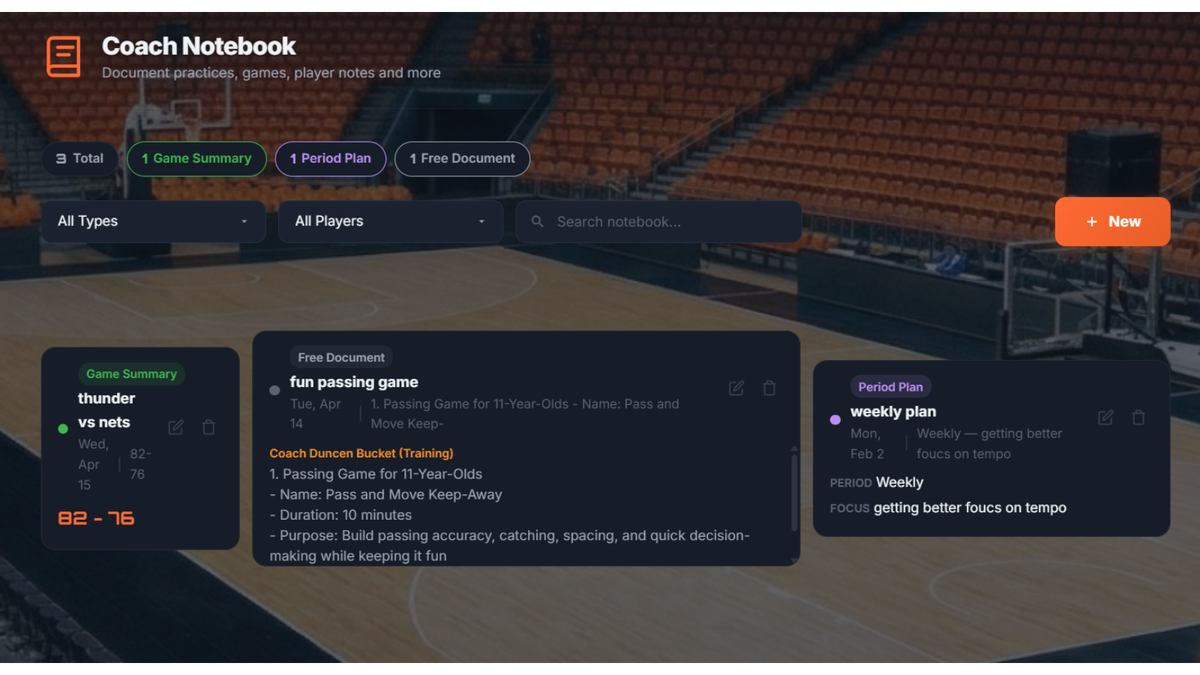
NextPlay's Coach Duncan - the AI basketball practice planner - is the specialist that takes the strategic direction (the Tactician's output, or your own decision) and translates it into a coachable practice program. It picks drills, sequences weeks, and explains why each piece matters. You change 30%. You run the rest. The practice ↔ strategy gap closes.
The loop matters more than any one piece
Here's the part that's harder to see if you're looking at any one of these tools in isolation:
A scouting report, on its own, is just information. A style recommendation, on its own, is just an opinion. A practice plan, on its own, is just a Google Doc (if you want a structured starting point, grab a free basketball practice plan template - printable PDF, no signup). The reason coaches with great game plans still lose games to lesser teams is that the layers don't talk to each other.
The shift that matters - the one that turns AI tools into something a real head coach uses - is when the layers share context:
- Scout tells you what the opponent does.
- Analytics tells you what your team does well against it.
- Tactician picks the style that exploits the gap.
- Coach Duncan turns that style into the next two weeks of practices.
When these specialists share the same workspace and the same data, the game plan stops being "what I think we should do" and starts being "what the data, my judgment, and a coaching staff that's all on the same page says we should do."
The reason NextPlay is built as five specialist AI coaches instead of one general-purpose AI assistant is exactly this. A general-purpose AI is fine for one-off questions. It can't carry the team's context from a Scout conversation into a practice-planning conversation into a strategy review. The specialists can. That's the design.
What AI can't do (the boundaries)
I'm going to repeat the part I said in the first post, because it's the part that matters most:
- AI doesn't watch a kid's body language in week 2 and know she's getting bored with the new offense.
- AI doesn't know that the athletic director is making you cut practice time by 30% in February.
- AI can't make the call on whether this is the year to push for a deep playoff run or to develop your underclassmen.
- AI doesn't fall in love with a player who shouldn't be starting.
- AI doesn't tell the dad in the second row that his son is going to be coming off the bench tonight, and mean it.
The strategic judgment about what fits this team, this season, this group of kids - that's still yours. The data work that informs the judgment is the part that just got fast.
The good news: this means the more experienced you are as a coach, the more leverage these tools give you. They don't replace experience. They give experience more to work with.
Three things to try this week
If any of this resonated, here are three things you can do in the next seven days that don't require buying anything, signing up for anything, or learning anything technical:
1. Ask an AI tool to suggest a style of play for your roster. Give it the basics: ages, positions, skill levels, what you've been running. Read what it suggests. Don't accept it. Just notice which parts feel right, which feel off, and which made you think about something you hadn't thought about.
2. Pick one strategic goal and break it into 4 weeks of practices. Pace. Switching defense. Better screening. Whatever you'd actually want this team to develop. Ask the tool, "If I wanted my team to be noticeably better at X by Christmas, what would the next four weeks of practices look like?" Read the answer. Adjust. Try one week of it.
3. Build one game plan with AI scaffolding. Next opponent. Tell it your roster, their roster, what you remember from last time you saw them. Let it propose a game plan. Critique it. Take the parts you agree with into Monday's practice.
The point of all three of these isn't "the AI gets it right." The point is to react to something instead of generating it. Reacting is faster, more strategic, and harder to do at 11 PM on Sunday with a blank page.
Where this is going
The coaches I respect have always been one part teacher, one part strategist, one part operator. The operator part - the planning, the data work, the bookkeeping - is the part AI is quietly eating.
That's the most valuable thing about this whole shift. The hours that used to go into shuffling spreadsheets and rebuilding practice plans from scratch every Sunday night now go back into the parts of the job that actually matter: watching practice with full attention, talking to the kids individually, making the calls that take judgment, and being present.
NextPlay's bet is that the strategy-to-practice loop - Scout → Analytics → Tactician → Coach Duncan - is the part of the coaching job that benefits most from this. The data work, the style fit, the practice progression: all of that runs in the background. You step in for the judgment calls and the moments that make a coach.
If you've been wanting to try this, the NextPlay AI basketball coaching staff is free for 14 days. No credit card. The Tactician and Coach Duncan are part of the staff from day one.