It's the first Monday of pre-season. You're standing at center court. Twelve kids in front of you - sizes ranging from "wait, was he this tall last year?" to "I think his growth spurt is six months away."
You already know what offense you're going to install. You watched two college games last weekend. You're going to run dribble-drive. Pace and space. Five-out. Read and react. The whole modern toolkit.
Three weeks later you're going to wonder why your team can't get into the third action of any possession without turning the ball over.
The mistake almost every U13-U14 coach makes is the same one: picking the system before they know the roster. At this age it doesn't work the way it does in high school. Your kids haven't read enough defense to react to it. They can't pass on the move consistently. The "second read" doesn't exist yet because the first read is still a coin flip.
The fix is simple, even if it isn't fast: audit the roster first. Pick the system that fits them. Keep the action menu small. Repeat it until December.
This is the post about that.
The roster decides the system, not the other way around
I want to make this argument once and then move on.
At U13-U14 you have between 14 and 22 practices before games start. You have 12 kids with wildly different skill levels and bodies. The "great college system" you saw on TV was run by 20-year-olds who'd done the same offense for four years. Your 13-year-olds don't have four years. They have eight weeks.
So you have a choice. You can install the offense you want to coach - and spend eight weeks watching it fail in slow motion. Or you can install the offense that fits the kids in front of you, and spend those eight weeks getting it actually clean.
The framework for the rest of this post:
- Identify which of five roster archetypes you have
- Pick the base system that matches it
- Run a 2-practice audit to confirm
- Avoid the four mistakes most coaches make
- Commit to one base - don't try to run three offenses
Five roster archetypes you'll see at U13-U14
After enough years, you start to recognize the same five teams over and over.
1. The multi-handler team, no real big. Three or four kids can bring the ball up without panicking. Nobody is a real interior force, but you have enough guards to survive pressure. The problem isn't getting the ball over halfcourt. The problem is finishing possessions without turning them into one-on-one soup.
2. The one-scorer team. You know it in the first scrimmage. One kid takes every tough shot, every bailout, every "fine, I'll do it myself" shot. The other four look functional in small doses. This team can win, but only if you use the scorer like a weapon - not like a hostage.
3. The big-and-slow team. You win the paint and lose the sideline. This group rebounds, screens, occupies space. They can't run, but they can punish smaller teams. If you try to play fast all game you're handcuffing your own strength.
4. The athletic-but-small team. Looks dangerous in warmups. Annoying in games. They run, they pressure, they jump passing lanes. But if they have to score against a set defense, things get ugly fast unless the spacing plan is clean.
5. The skill-gap roster. The top 3 can actually play. The bottom 7 are still learning to catch cleanly and pass on time. This is the classic youth team. If your system asks all 10 kids to be equally competent, you've already lost the room.
The system that fits each archetype
Once you know which team you have, the menu of "right offenses" shrinks fast.
| Roster archetype | Best base offense | Keep all season | Skip entirely |
|---|---|---|---|
| Multi-handler, no real big | 5-out motion | Pass-and-cut, dribble-at backdoor | Princeton-style splits, complex post entries |
| One-scorer, support cast | 4-out 1-in + horns entry | Horns to scorer on the wing, clear-side iso | Free-form motion that asks role players to create |
| Big-and-slow | High-low + early post seal | Elbow high-low, rebound-and-seal | Drag screens, spread pick-and-roll every trip |
| Athletic-but-small | 5-out + transition primary | Rim-run, cut-and-fill from 5-out | Post-ups, slow half-court sets |
| Skill-gap | Simple 4-out 1-in + 1-2 sets | Secondary break, one-side PnR for top players | Multiple systems, "read the whole floor" |
The pattern: at this age the best offense is the one that forces the right action without asking kids to read the defense five layers deep. Spacing rules, simple actions, repeated until automatic.
"If the kids can't make the first pass, don't install an offense that needs the third read."
That's the rule. Hold it.
The 2-practice roster audit
Here's how to figure out which archetype you have in the first two practices - not by guessing, by recording.
Practice 1: skill + decision audit
- Mikan progression / two-line finishing. Watch: can they finish with either hand? Do they catch and go, or need three steps to think? Record: left-hand makes, right-hand makes, fumbled catches.
- Wing 1-on-1 live. Watch: who can create separation? Who can stop the dribble without traveling? Record: who beats pressure, who turns it over, who can't stay in front.
- Pass-and-cut shell (3-on-0 → 4-on-4). Watch: chest pass on time? Hard cut after passing? Record: clean passes, lazy passes, ball-watchers.
Practice 2: system-fit audit
- 3-lane break / numbers-advantage break. Watch: lane fills? Who runs to space versus to the ball? Record: rim runners, trail players, first-pass accuracy.
- 3-on-2 continuous / 4-on-3 continuous. Watch: do they find the open player? Stop the ball? Make the extra pass? Record: assist quality, spacing mistakes.
- 5-on-0 walk-through into live 5-on-5. Watch: who remembers spacing? Who can set a legal screen? Record: correct spots, screen quality, shot quality.
What you're really building from these two practices is a short scouting report on your own team: who handles pressure, who finishes, who passes on time, who screens, who rebounds, who defends without fouling.
Once you have that report, you don't pick the system. The system picks itself.
How to actually use the report
After Practice 2, sit down for 20 minutes with the two pages of notes. Three quick passes through it:
- Circle the bottom 3 names. Whatever offense you pick has to be playable by those three on a bad day. If the system breaks when your weakest catcher is on the floor, the system is wrong.
- Highlight the strongest 1-2 traits on your roster. Bigs who can screen? Guards who can pressure? An athletic wing? Build the base around that - not around the gap you're trying to hide.
- Cross-check your gut. If your audit points at 4-out 1-in but you've been mentally installing 5-out for weeks, pause. The data is usually right at this age - the coach's preference is usually wrong.
The four mistakes everyone makes
The biggest mistakes at U13-U14 aren't tactical. They're philosophical.
- Installing a system before knowing the roster. That's not coaching. That's costume design.
- Running college-level read-and-react with kids who can't make the kick-out pass yet. If the pass is late, the read is dead. Brutal math.
- Confusing "more options" with "better offense." At this age, more options usually means more confusion. One good action beats five half-understood ones.
- Ignoring the bottom 7. Your top 3 may save you on talent. Your bottom 7 decide whether the team functions or falls apart. If those kids can't catch, space, and screen, your offense has a leak in the hull.
The quotable line I want you to walk out with:
"Don't teach a Ferrari offense to a bicycle roster."
That one's worth pinning on the inside of your clipboard.
Commit to one base. Keep one fallback. That's it.
At U13-U14 the sweet spot is one base offense + one simple changeup against pressure or zone, plus maybe two set plays for end-of-quarter looks. That's the whole menu.
Why?
- Kids this age need repetition. The game slows down when they see the same spacing, same cuts, same triggers every week.
- They also change fast - growth spurts, confidence swings, new skills. Your base can't be a prison, but it has to be a base.
- In high school you can specialize more because players process faster. At U13-U14 the season is too short and the learning curve too steep to teach three offenses badly.
Pick one base. Hold it. Rebuild it from the roster up if your team changes next year.
The honest version of "flexibility" at U13-U14 is this: your base handles 80% of possessions, your changeup handles pressure or zone, and your two set plays handle the moments where you actually need a bucket - end of quarter, after a timeout, sideline out-of-bounds. That's it. If you're carrying more than that into November, you're not flexible. You're scattered.
"At U13-U14, the best offense is the one your fifth-best player can survive."
Print that. Stick it next to your clipboard, right under the Ferrari line.
Where this fits in the bigger loop
Picking the system is step one. Translating it into the next four weeks of practices - what drills, what sequencing, what to cut - is the second half of the job. A great system you can't install is just another opinion.
The next post in this series goes after the defensive version of the same problem: how to build a defensive identity in four weeks, again with the roster you actually have, not the one you wish you had.
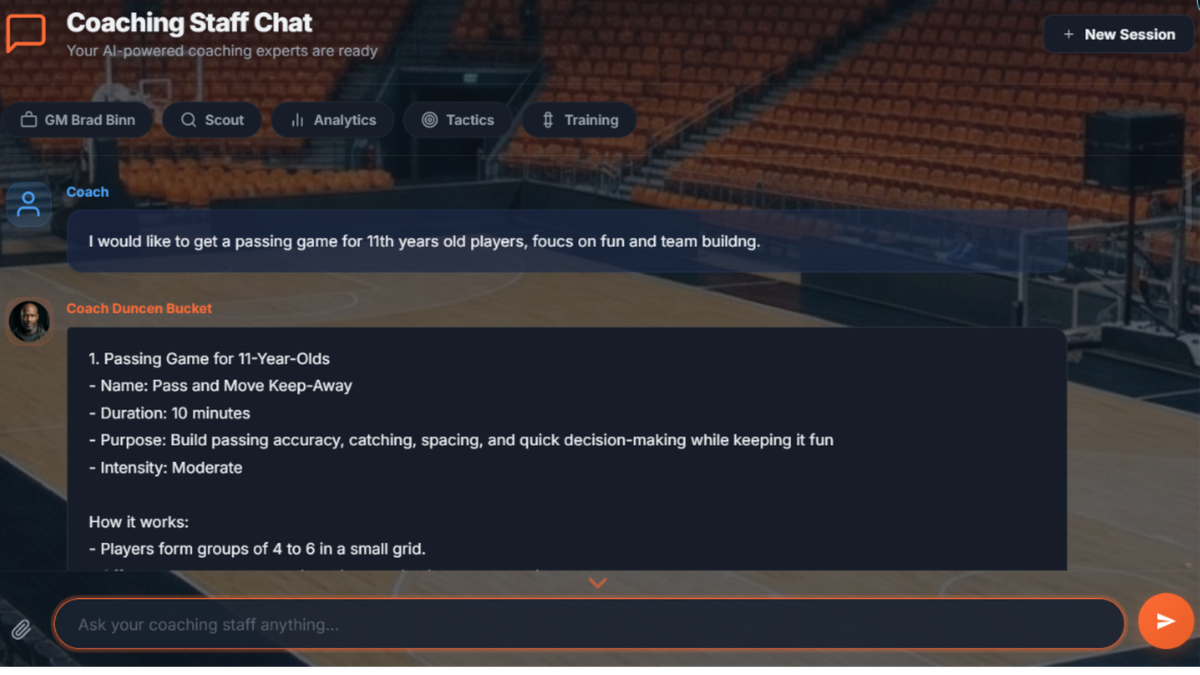
If you want NextPlay's Ed Vance - the Tactician on our 5-coach AI staff - to do this audit with your actual roster, he can take your players' heights, skill levels, and what you noticed in last year's tape, and recommend a base offense with the tradeoffs spelled out. The roster-fit work he does in five minutes is the same Sunday-afternoon work most head coaches do in their head every August.
NextPlay's basketball coaching software is free for 14 days. No credit card. Ed Vance is part of the staff from day one.