Fourteen kids. One court. Seventy five minutes, if the volleyball team clears out on time.
That is an ordinary night in youth basketball, and it is the setup most plans online quietly ignore. They assume six baskets, a full staff and players who arrive warmed up. You get two baskets, maybe one parent who said "I can help," and fourteen players who all want the ball at once.
The plan below is built for exactly that gym. It runs 75 minutes to the minute, it never leaves a line longer than four players for long, and every block has one coaching point, not five.
The rules this plan is built on
Three rules decide almost everything below. If you change the drills, keep the rules.
Use both baskets, all the time. One court has two baskets, and a practice that uses one of them wastes half the gym. Fourteen players split into two groups of seven, one per basket, is the backbone of most of this plan.
Keep the lines short. In a line of seven sharing one ball, each player is active one turn in seven. Split the same seven into a shooting line and a rebounding line and the waits halve. The plan below splits every line it can, and it uses stations when it cannot.
Every block gets a clock. Write the start time of each block on the plan and run a visible timer. The most common way a 75 minute practice turns into 50 minutes of drills and no scrimmage is a warm up that ran long because nobody was watching the time.
The plan at a glance
Written for players around 11 to 14, one head coach and one helper.
| Minutes | Block | Where | Groups |
|---|---|---|---|
| 0 to 8 | Dynamic warm up and ball handling | Full court | All 14 |
| 8 to 18 | Layup lines, both hands | Both baskets | 7 at each basket |
| 18 to 33 | Three skill stations, 5 minutes each | Two baskets and one sideline | Groups of 5, 5 and 4 |
| 33 to 35 | Water | ||
| 35 to 47 | Closeout and contain, 1 on 1 | Both baskets | 7 at each basket |
| 47 to 59 | 3 on 3, one player rotating in | Both baskets | 7 at each basket |
| 59 to 61 | Water | ||
| 61 to 71 | Controlled scrimmage | Full court | 10 playing, 4 rotating |
| 71 to 73 | Pressure free throws | Both baskets | 7 at each basket |
| 73 to 75 | Huddle | Center circle | All 14 |
What you need: a ball for every player if you can get it (ask them to bring their own), about a dozen cones, two sets of pinnies, a whistle and a timer the whole gym can see.
Minutes 0 to 8: warm up with a ball in every hand
Skip the laps. A warm up that has a ball in it is a warm up that also teaches something.
Line the players up along the baseline in two or three rows and work down the floor and back:
- Jog and dribble with the right hand, back with the left.
- High knees and butt kicks, dribbling the whole way.
- Defensive slides to half court and back, no ball, low stance.
- Stationary dribble series at the far baseline: pound dribbles, crossovers, between the legs, ten of each.
The one coaching point: eyes up. Call out a number of fingers you hold up and have them shout it back while they dribble.
Minutes 8 to 18: layup lines at both baskets
Seven players per basket, in two lines: a shooting line at the right wing, a rebounding line at the left. The shooter dribbles in for a right handed layup, the rebounder catches it before it hits the floor and passes to the next shooter, and both switch lines.
Five minutes on the right side with right handed layups, five minutes on the left side with left handed layups. With two lines of three or four, nobody waits more than a few seconds.
The one coaching point: the last step. Right hand layup means a left foot takeoff, and the left side is the mirror image. Most young players get this backwards on the weak hand, so spend the left side minutes watching feet, not the ball.
Minutes 18 to 33: three stations, five minutes each
Split into three groups of 5, 5 and 4. Every group visits every station once, rotating on your whistle every five minutes.
Station A, basket one: form shooting. Start one step from the rim, one hand only, five makes, then step back. Five spots around the basket. Shots count only if the follow through holds until the ball lands.
Station B, basket two: finishing. The Mikan drill, alternating layups under the rim without letting the ball touch the floor, then reverse layups from both sides. Two players work while the others rebound and feed.
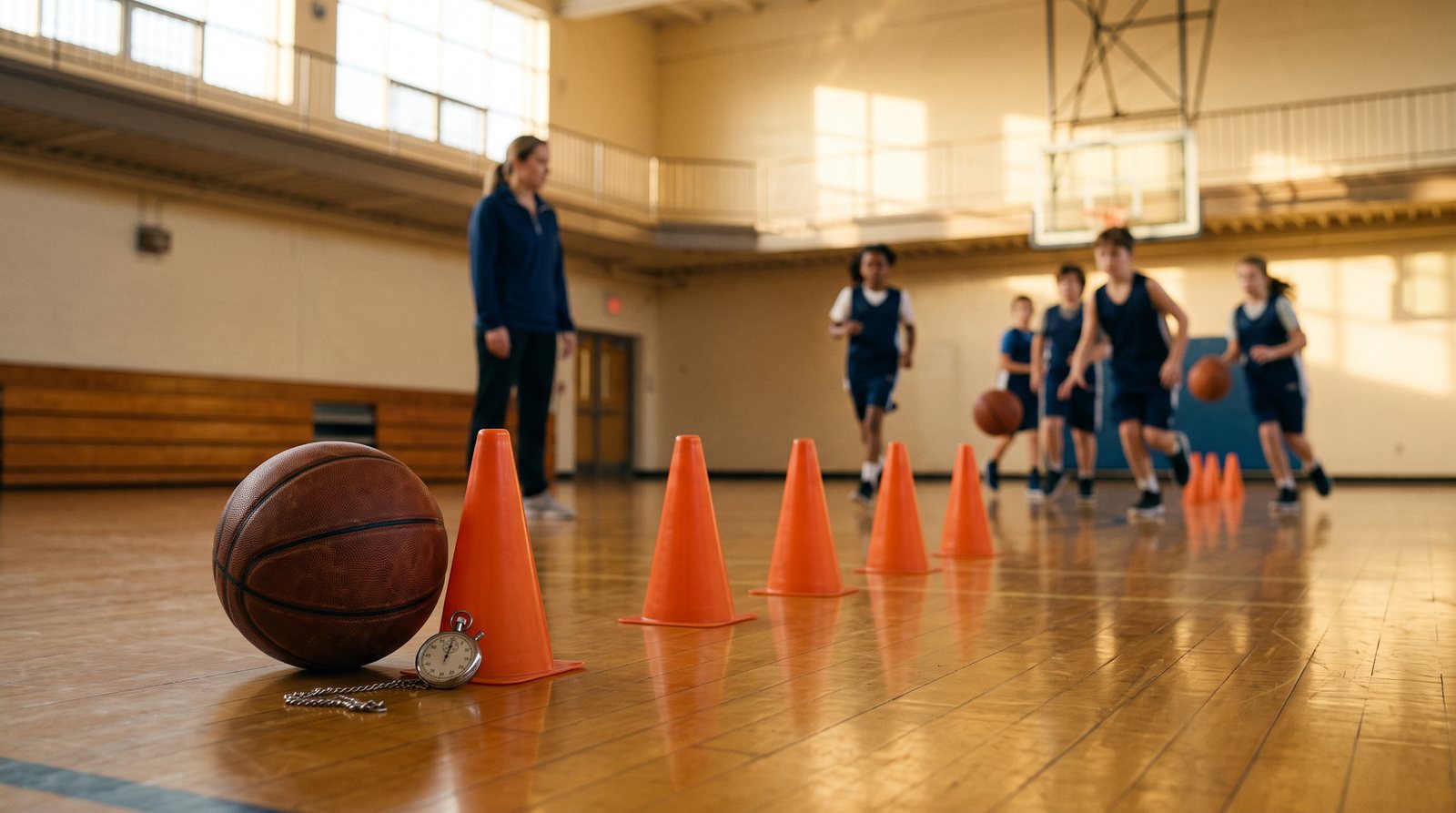
Station C, one sideline: ball handling course. A zigzag of cones between the three point line and the sideline. Crossover at every cone on the way down, a different move on the way back. This is the station your helper runs, because it needs the least correction and the most counting.
The one coaching point at each station is written on a card on the floor next to it, so your helper does not need to remember what to say.
Minutes 33 to 35: water
Two minutes, timed. While the players drink, set up the next block: one ball at each basket, cones off the floor.
Minutes 35 to 47: closeout and contain, 1 on 1
This is the defensive block, and it is the one that pays off fastest in games.
At each basket, offense lines up on the wing and defense lines up under the basket. The defender passes to the wing and closes out: sprint the first part of the distance, then short choppy steps, hand high on the shooting side. The offensive player gets two dribbles to score. Then each player moves to the back of the other line.
With seven at a basket, three pairs rotate and the seventh player is the next defender, so nobody stands still for long.
The one coaching point: the choppy steps. A defender who sprints all the way gets driven past every time. Count "chop chop chop" out loud for the first few reps.
Minutes 47 to 59: 3 on 3 with one player rotating in
Six play at each basket, one waits. Each possession starts with a check at the top of the key. When a team gets scored on, one of its players rotates out and the waiting player comes in, so the waiting time is short and the losing team still gets to compete.
Add one rule that matches what you taught earlier: a basket off a drive counts only if the defender closed out first. The offense has to make the defense close out, and the defense has to close out properly to get a stop.
Minutes 59 to 61: water
Same two minutes. Pinnies on for the scrimmage.
Minutes 61 to 71: controlled scrimmage
Ten players on the court, four on the sideline. Rotate four players in every two and a half minutes, and keep a quick note of who sat so everyone plays about seven of the ten minutes.
Control it with one constraint, not five. For younger groups, every player on the team has to touch the ball before a shot. For older ones, try three passes before a shot unless it is a layup in transition. Stop play only for the thing you taught today, closeouts and finishing, and let the rest go.
If you want a fuller system for equal minutes in real games, the same idea is laid out in the youth basketball rotation chart.
Minutes 71 to 73: pressure free throws
Seven players at each basket, one free throw each, everyone else silent. Count the makes at both baskets and announce the team total. Next practice, the goal is to beat it.
Free throws at the end, on tired legs and with the whole team watching, are closer to a game free throw than fifty shots at the start of practice.
Minutes 73 to 75: huddle
Two minutes, three things: one thing the team did well today, one thing to work on, and when the next practice or game is. Then let them go. A long speech at the end of practice is mostly heard by parents waiting at the door.
When you have 60 minutes instead of 75
Cut 15 minutes without losing the shape:
- Run two stations instead of three, finishing and ball handling. That saves 5 minutes.
- Shorten 3 on 3 to 7 minutes. That saves 5.
- Scrimmage for 5 minutes instead of 10. That saves 5.
Keep the warm up, the layups, the closeouts and both water breaks. The water breaks are not optional for kids this age, and the closeout block is the part that shows up on Saturday.
When you have 90 minutes
Add one 15 minute block after the second water break: a team offense block where you walk and then run one set or one press break. Fifteen minutes is the right size for a single install step, and the full progression is in how to install a basketball play in three practices.
When fewer kids show up
With 10 players, split 5 and 5 at the baskets, run the stations as groups of 4, 3 and 3, and play 2 on 2 instead of 3 on 3 so the waits stay short. With 8, everything still works at two baskets, and the scrimmage becomes 4 on 4 with no subs.
Turning this into your own plan
The plan above is a template. Your version should swap the station drills for whatever your team needs this week, and keep the times, the groups and the rule of one coaching point per block.
The practice planner builds a timed plan like this one around your own numbers. You can also tell Duncan, the training specialist on the NextPlay coaching staff, "75 minutes, one court, 14 kids, U13, we need closeouts this week," and he builds the plan and saves it to the practice in your calendar, where you can open it at the gym on your phone. If the plan comes out of a game plan, the logic behind that step is in from game plan to practice plan.
Frequently asked questions
How long should a youth basketball practice be?
Sixty to ninety minutes covers most youth teams, and 75 is a comfortable middle for players around 11 to 14. What matters more than the length is that every block has a set time and that the plan keeps players moving. A 60 minute practice with short lines teaches more than a two hour practice with long ones.
How do you run a practice with 14 players and one court?
Use both baskets all the time, split the team into two groups of seven, and break every long line into a shooting line and a rebounding line. When a drill only needs a few players, use stations: two at the baskets and one on a sideline, with groups of five, five and four rotating every five minutes.
What should a basketball practice plan include?
A warm up with the ball, a finishing block, skill work in small groups, a defensive block, competitive small sided games, a short scrimmage, free throws and a closing huddle. Add two short water breaks. Give each block one coaching point so players know exactly what you are watching for.
How many drills should be in a 75 minute practice?
Eight to ten blocks, each with one clear purpose, is plenty. More drills means more transitions, and every transition costs a minute or two of standing around. Repeating the same drill across a few weeks, with a harder rule each time, usually teaches more than a new drill every practice.
When should water breaks happen in youth basketball practice?
Plan them into the schedule rather than waiting for players to ask. In a 75 minute practice, two timed breaks of about two minutes each, roughly a third and two thirds of the way through, work well. Use the break to set up the next block so the practice restarts immediately.
What if the drills take longer than planned?
Cut the end of the block, not the water break or the scrimmage. A visible timer and the start time of every block written on the plan make overruns obvious while there is still time to fix them. If the same block runs long every week, make it shorter in the plan rather than fighting it in the gym.
The practice planner turns this template into a plan around your own roster, court and time, and the whole NextPlay coaching staff is free for fourteen days with no card.