You promised the parents equal minutes. You meant it.
Then the game started. The first quarter went fast, two kids picked up early fouls, the other team went on a run, and somewhere in the third quarter you looked down the bench and realized one of your players had not been on the floor since the opening tip. Nobody did it on purpose. Nobody was keeping count.
Equal minutes is easy to promise and hard to deliver from the sideline, because the sideline is the worst place in the gym to do arithmetic. The fix is to do the arithmetic before the game, put it on one sheet of paper, and let the sheet make the decisions you would otherwise make in a hurry.
This post gives you that sheet for a ten player roster, the math for eight to twelve players, and the rules for the moments when the plan meets a real game.
The math comes first
Five players are on the floor at all times. So a game always contains the same number of player minutes: five times the length of the game. Divide that by the number of players who showed up and you have the equal share.
| Players dressed | Four 8 minute quarters (32 min game) | Four 10 minute quarters (40 min game) |
|---|---|---|
| 8 | 20:00 each | 25:00 each |
| 9 | 17:47 each | 22:13 each |
| 10 | 16:00 each | 20:00 each |
| 11 | 14:33 each | 18:11 each |
| 12 | 13:20 each | 16:40 each |
If your league plays a different format, the formula is the same: five times the game length, divided by the players you have. Two 16 minute halves is the same 32 minute game as four 8 minute quarters.
Ten players is the friendly number. Everyone plays exactly half the game. That is why the chart below is built for ten, and why the sections after it deal with the rosters that do not divide so neatly.
Plan in shifts, not minutes
You cannot substitute on an exact second. Most rule sets only let you change players on a dead ball with the clock stopped, so a plan that says "Maya plays 16:00" is a plan you cannot execute.
Plan in shifts instead. Cut every quarter in half:
- In an 8 minute quarter, a shift is about 4 minutes.
- In a 10 minute quarter, a shift is about 5 minutes.
That gives you eight shifts in a game, and eight shifts times five spots is 40 player shifts to hand out. With ten players, that is exactly four shifts each.
The shift ends at the first legal substitution after the clock passes the halfway mark of the quarter. Some shifts will run long, some will run short. Over four shifts it mostly evens out, and the section on tracking real minutes covers the part that does not.
The rotation chart for 10 players
The method that makes this work is position pairs. Put your ten players into five pairs by role, and each pair shares one spot on the floor all game. One player in the pair takes the odd shifts, the partner takes the even ones.
For a typical youth roster:
- Guards: Guard 1 and Guard 2
- Wings: Wing 1 and Wing 2, Wing 3 and Wing 4
- Forwards: Forward 1 and Forward 2
- Bigs: Big 1 and Big 2
Then the chart. A dot means on the floor, a middle dot means on the bench.
| Player | Q1 start | Q1 mid | Q2 start | Q2 mid | Q3 start | Q3 mid | Q4 start | Q4 mid | Shifts |
|---|---|---|---|---|---|---|---|---|---|
| Guard 1 | ● | · | ● | · | ● | · | ● | · | 4 |
| Guard 2 | · | ● | · | ● | · | ● | · | ● | 4 |
| Wing 1 | ● | · | ● | · | · | ● | · | ● | 4 |
| Wing 2 | · | ● | · | ● | ● | · | ● | · | 4 |
| Wing 3 | ● | · | ● | · | ● | · | ● | · | 4 |
| Wing 4 | · | ● | · | ● | · | ● | · | ● | 4 |
| Forward 1 | ● | · | ● | · | · | ● | · | ● | 4 |
| Forward 2 | · | ● | · | ● | ● | · | ● | · | 4 |
| Big 1 | ● | · | ● | · | ● | · | ● | · | 4 |
| Big 2 | · | ● | · | ● | · | ● | · | ● | 4 |
| On the floor | 5 | 5 | 5 | 5 | 5 | 5 | 5 | 5 | 40 |
"Start" is the first half of the quarter, from the opening whistle to the halfway mark. "Mid" is the halfway mark to the end of the quarter.
Three things are built into that chart on purpose.
Every lineup has a shape. Each of the eight lineups has one guard, one big, and three wings or forwards. You never end up with three bigs and no ball handler because the minutes happened to land that way.
The halftime flip. In the first half, the odd shift players form one group and the even shift players form the other. That is two fixed units, which has a cost: your weaker unit plays together for half the game, and the kids on it never share the floor with your best players. So at halftime two pairs swap who takes the odd shift, Wing 1 with Wing 2 and Forward 1 with Forward 2. Everyone still gets four shifts, but the second half lineups are mixed.
Nobody sits two shifts in a row inside a half. The longest rest any player gets is across halftime, where Wing 1 and Forward 1 sit the end of the second quarter and the start of the third. The halftime break is already a rest, so nobody goes cold for a full quarter of game time.
Decide who closes before the game starts
Look at the last column. Guard 2, Wing 1, Wing 4, Forward 1 and Big 2 are on the floor for the final shift of the game. That is your closing five, and the chart picked it.
If you want a different five on the floor at the end of a close game, do not fix it in the fourth quarter by breaking the chart. Fix it before the tip, by deciding which player in each pair takes the odd shifts and which takes the even ones. The minutes stay equal. You are only choosing the order, and you are choosing it calmly, in the locker room, instead of with 1:40 left and a parent staring at you.
When the game does not follow the chart
It will not, at least once a game. The pairs are what make the fixes simple, because the replacement is always obvious: the partner plays the same role.
Foul trouble
A player picks up two quick fouls in the first quarter and you want them out. Their partner covers the shift, and the player in foul trouble takes one of the partner's later shifts in exchange. Same total, different order. Write the swap on the chart the moment you make it, or you will forget it by the third quarter.
An injury or a late arrival
Same rule. The partner covers, and the missing shift gets paid back later in the game if the player returns, or in the next game if they do not.
Nine players, or eleven, or twelve
Forty player shifts only split evenly for eight or ten players. For everyone else, some players get one shift more than others.
| Players dressed | Shifts per player, eight shifts a game |
|---|---|
| 8 | 5 each |
| 9 | 4 players get 5, 5 players get 4 |
| 10 | 4 each |
| 11 | 7 players get 4, 4 players get 3 |
| 12 | 4 players get 4, 8 players get 3 |
One shift is about four minutes in an 8 minute quarter. That gap is fine for one game. It is not fine if it lands on the same kids every week.
So keep a season tally. One line per player, one tick per shift played. Before each game, the extra shifts go to whoever is lowest on the season tally. Across a season, equal minutes is a total, not a promise you keep perfectly in every single game.
Track the real minutes, not the planned ones
The chart is the plan. What actually happened is different, because dead balls do not arrive on schedule. One player's four shifts might add up to 14 minutes and another's to 18.
Give the chart to an assistant or a parent volunteer and ask for one thing: the game clock each time a player checks in and checks out. That takes no basketball knowledge and fits on the back of the chart. After the game, add it up. If someone came up short by a couple of minutes, they start the next game. Small corrections every week beat a big argument in February.
Then put the real minutes where you will see them again. In NextPlay, the box score on each game has a minutes column, and the stats report shows each player's minutes across the season, so you can see who actually played what instead of what the chart promised.
Equal minutes is a choice, so make it on purpose
Equal playing time is the right default for development ages, and many recreation leagues require some version of it. Check your league's rule sheet before the season, because some leagues set a minimum per player, or a minimum number of quarters, and the chart has to be built from that rule backward.
Older and more competitive teams usually do something else, and that is a legitimate choice too. What does not work is not choosing, and letting the scoreboard decide each night.
A middle ground that holds up well is a guaranteed minimum plus earned minutes. Using the same 40 player shifts:
- Guarantee every player two shifts. With ten players that uses 20 shifts.
- The other 20 shifts are earned, through practice effort, execution and the game situation.
Everyone knows the floor they stand on, and the rest is competition. The math is the same tally as before, just with two columns.
Whichever system you pick, the conversation is cheaper before the first game than after the third one.
Tell the parents before the first game
Most playing time conflicts are not about minutes. They are about surprise. A parent who knows the system in advance argues far less with the outcome.
Something this short is enough:
Our playing time system this season: every player plays half of every game, in four shifts of about four minutes. If someone misses time because of fouls or an injury, they get it back next game, and I keep a season tally to make sure the totals even out. If you ever think the tally is wrong, tell me and we will look at it together.
Then keep the tally honest, because now somebody may ask to see it.
Practice the substitutions too
A rotation that looks perfect on paper falls apart if every substitution costs you a turnover and a timeout.
Spend five minutes in the last practice before a game running the changes:
- Every player knows their shifts by heart, and knows their partner's name.
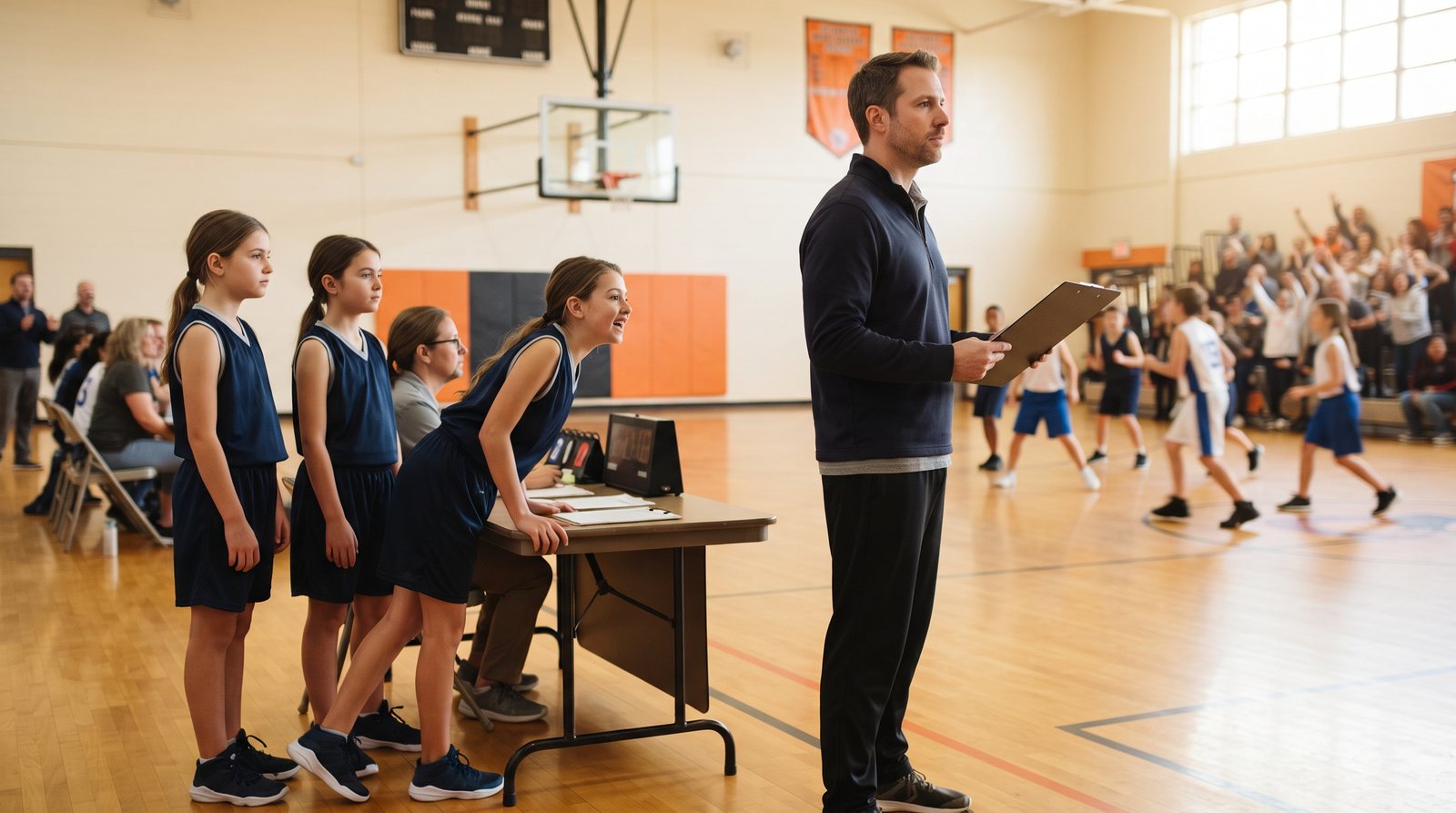
- At the halfway mark of each quarter, the next group is already standing at the scorer's table, not waiting to be called.
- The player coming off tells their partner who they are guarding before they leave the floor.
That last one is the habit that saves you a basket a game. A new player who runs onto the court and asks "who do I have?" is a defender short for the first possession.
Build the chart around your own roster
The chart above uses roles, not names, because every roster is different. Your two guards might not be your two best ball handlers. Your bigs might be your third and fourth tallest players. The pairing is the part that takes judgment, and it is worth twenty minutes before the season. If you are still working out which players fit which roles, matching your style to your roster is the place to start.
If you would rather not do it by hand, tell the NextPlay coaching staff your roster, your quarter length and your league's minimum minutes rule, and ask for a rotation chart. It builds one with your players' names on it, and you can change the pairs in plain words: "swap Noa and Daniel, and I want Noa closing." The staff works the shift totals out with a calculator rather than in its head, which is the part people get wrong at 10pm.
Frequently asked questions
How many minutes should each player play in youth basketball?
Multiply the game length by five and divide by the number of players. In a 32 minute game with ten players, that is 16 minutes each, exactly half the game. With eight players it is 20 minutes each, and with twelve it is 13 minutes and 20 seconds. Check your league's rules too, since some leagues set their own minimum per player.
How do you make a basketball rotation chart?
Split each quarter into two shifts, which gives you eight shifts and 40 player shifts in a game. Put your players into pairs by role, guard with guard and big with big, and give one player in each pair the odd shifts and the partner the even shifts. Swap two pairs at halftime so the second half lineups mix. With ten players, everyone gets four shifts.
How do you give equal playing time with 9 players?
Forty player shifts do not divide evenly by nine, so four players get five shifts and five players get four in any one game. Keep a season tally of shifts played and give the extra shifts to whoever is lowest on the tally before each game. Over a season the totals come out equal even though no single game does.
When should I substitute in youth basketball?
Plan the substitutions at the halfway mark of each quarter and make them at the first dead ball after the clock passes that mark. Have the next group waiting at the scorer's table before the mark so the change happens at the first legal chance and does not cost you a timeout.
What do I do when a player is in foul trouble?
Let their partner in the pair cover the shift, and give the player in foul trouble one of the partner's later shifts in exchange. The total minutes stay equal, only the order changes. Write the swap on the chart immediately so you do not lose track of it later in the game.
Should youth basketball be equal playing time?
For development ages, equal or close to equal minutes is the right default, and many recreation leagues require it. For older competitive teams, a guaranteed minimum for every player plus earned minutes on top is a common and fair alternative. Whichever you choose, tell players and parents before the first game.
The chart in this post is free to print and use. If you want it built around your own players, quarter length and league rule, the NextPlay coaching staff will draft it in a minute, and it is free for fourteen days with no card.