Every coach has seen the forty page playbook. Somebody's binder, handed down from a program two levels above yours, with eighteen set plays, four zone offenses, a full transition system, and a page of quotes on the inside cover.
It is a beautiful document. Nobody on the team has read past page six.
That is the whole problem with playbooks, and it has almost nothing to do with basketball. A playbook is not a record of everything you know. It is the list of things your players can execute on a Tuesday night in a loud gym when they are tired and the score is close. Every page you add past that line makes the earlier pages worse, because it dilutes the thing you actually wanted them to remember.
So this post is a template. Not a theory of offense, not a philosophy. A structure you can copy: what sections a playbook needs, how many pages each one gets, what most coaches wrongly stuff into it, and how to keep the whole thing alive once the season starts eating your Tuesdays.
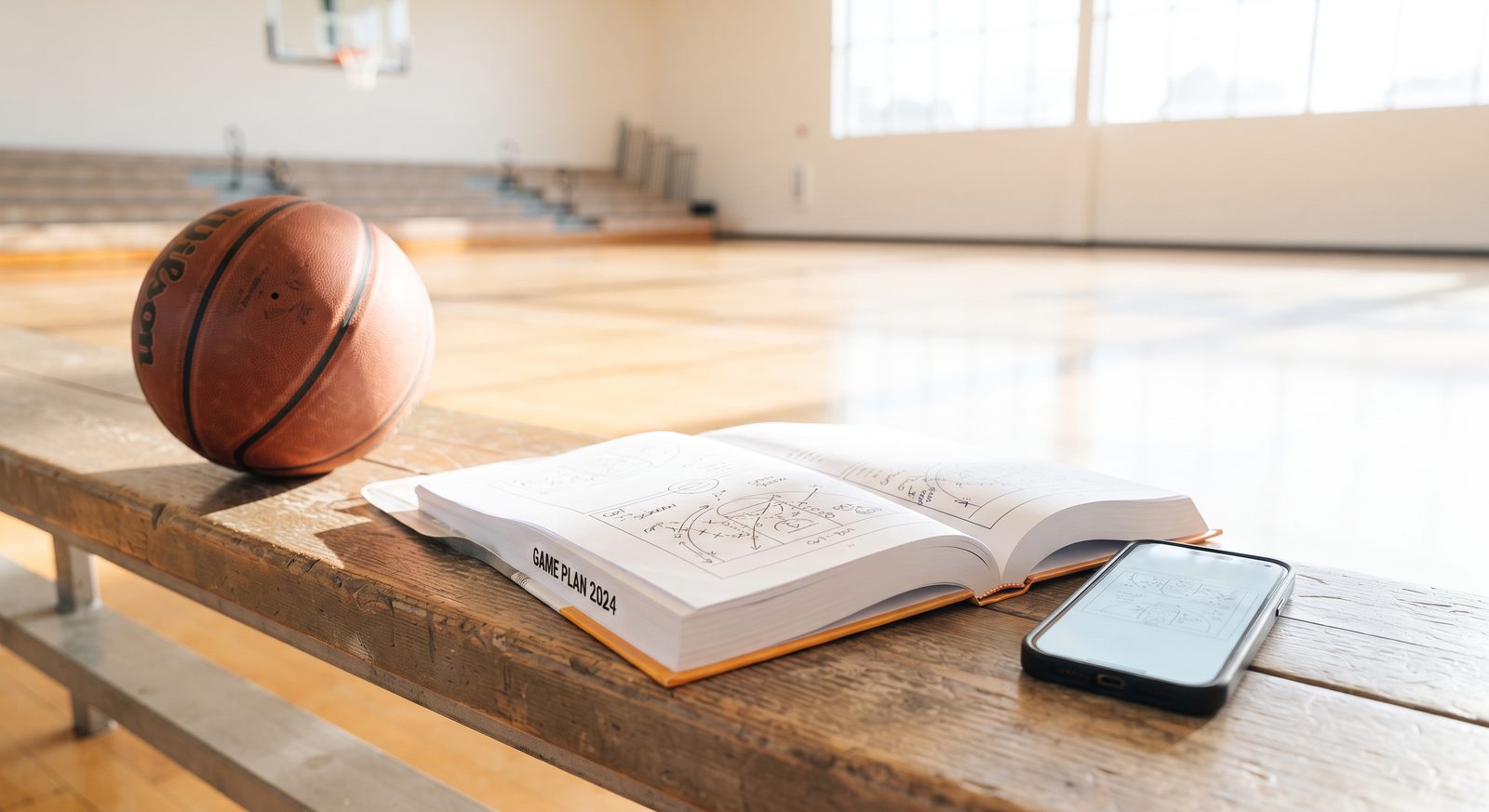
The only test a playbook has to pass
Before the template, the rule that generates it.
A playbook is finished when a player who missed two weeks can read it on the bus and be useful at practice. That is the test. Not "does it cover every situation." Not "does it look like a college program's." Can a kid who has been out with a sprained ankle catch up from the document alone.
Run that test against a forty page binder and it fails instantly. Nobody reads forty pages on a bus. Run it against three pages and it also fails, because three pages cannot tell a player where to stand against a 2-3 zone or what to do when the other team full court presses.
The honest number sits between eleven and thirteen pages, and the sections below are how I would spend them.
The template at a glance
| Section | Pages | The thing to cut |
|---|---|---|
| Team principles | 1 | Motivational quotes |
| Primary offense | 2 | Every possible counter |
| Secondary or early offense | 1 | A second break system |
| Set plays (two or three) | 2 | Sets you have never run in a game |
| Baseline and sideline out of bounds | 1 to 2 | A play per opponent defense |
| Press break | 1 | The zone press break you do not teach |
| Defensive rules | 1 to 2 | Full man and full zone packages |
| Special situations | 1 | Anything over ten seconds on the clock |
| Terminology | 1 | Words you do not actually say out loud |
Eleven pages if you are disciplined, thirteen if your league gives you a lot of out of bounds work. Beyond that you are writing for yourself, not for the team.
Where NextPlay is on this, plainly. Today our Team Playbook holds the plays themselves and gives your team one live link to them, so the diagram pages of the document above are covered and the rest are still yours to write. We are building the playbook out to carry the whole document, the principles page, the press break, the defensive rules and the special situations, so a coach can keep all of it in one place and hand it over with the same link. That work is in progress and this post will say so when it lands.
What goes in each section
Page 1: team principles
One page, before any diagram. Five to eight lines, each one a rule the team can be held to.
Good principles are testable in a film session. "We do not leave the paint on a drive until the ball is out." "First pass beats first dribble in transition." "Every shot has two crashers and three back." A player can look at those and know instantly whether the last possession obeyed them.
What most coaches wrongly include: inspirational language. "We play with heart." "Defense wins championships." These feel like principles and function like decoration, because no possession can ever violate them. If a line cannot be broken on tape, it is not a principle, it is a poster. Put the poster in the locker room and give this page to rules.
This page is also where your offensive identity gets declared in one sentence, and that sentence should follow from your roster rather than from the college game you watched in July. If you have not done that audit yet, matching your offense to your roster is the step that comes before this document exists at all.
Pages 2 and 3: primary offense
Two pages. The first shows the alignment and the spacing rules. The second shows the two or three actions that repeat inside it.
Page one of the pair is a single diagram with your base spots marked and four or five bullets: where the ball starts, what the spacing distance is, what every player does after they pass, and what the reset looks like when the possession breaks down. That last bullet is the one coaches skip and players need most.
Page two is the action menu, which at almost every level below college should hold two actions, or three if your group is experienced. Pass and cut. Dribble at, backdoor. One ball screen entry. That is a complete offense for a season.
What most coaches wrongly include: every counter to every defensive response. Your playbook should show what the offense does. What it does when they switch, when they hedge, when they go under, when they top lock, that is practice material, and it belongs in the drill you run on Thursday, not in a diagram the kid reads once. A written counter is a counter nobody has reps in. Counters live in legs, not in paper.
Page 4: secondary or early offense
One page. What happens in the first eight seconds, before the base offense starts.
Lane assignments in transition, who rim runs, who trails, where the ball goes on the first pass, and the one early action you want when the break does not produce a shot. Drag screen, trail entry, quick post seal, pick one.
What most coaches wrongly include: a second, separate break system for "numbers" versus "no numbers." Your team already reads that instinctively. What they do not read is where the fourth and fifth players go, so spend the page on lanes and spacing instead of on decision trees.
Pages 5 and 6: set plays
Two pages, two or three plays total, one diagram set per play with the frames laid out in order.
A set play earns its page by answering a question you can name. "We need a three coming out of a timeout." "We need a look for our best scorer at the end of a quarter." "We need a first possession of the second half that scores without a dribble." Three questions, three plays. If you cannot name the question a play answers, it does not go in.
What most coaches wrongly include: the sets they love from somewhere else. Everyone has two or three plays they have collected from clinics and never run in a live game. Those are drafts, not playbook pages. Keep them in a folder. A set play that has never been run in a game is a page that steals attention from the ones that have.
Page 7: baseline and sideline out of bounds
One page, occasionally two. Two baseline plays (one against man, one against zone) and one sideline play. That is the whole section for most teams.
Out of bounds is where the page to value ratio is highest in the entire playbook, because these are the only possessions that start from a known position with a known clock. A team that runs two BLOBs cleanly will out score a team that runs six badly, every time.
What most coaches wrongly include: a dedicated play for each defensive look they might see. Two plays that your team can execute under pressure beat six that produce a five second call. If your league plays a lot of zone, make the second baseline play the zone one and stop there.
Page 8: press break
One page. One alignment, one set of rules, one release valve.
The rules matter more than the diagram here: who inbounds, who gets the ball first, what the middle player does, and the one instruction that saves more possessions than any pattern, which is that the ball goes forward or it goes back to the middle, never along the sideline into the trap.
What most coaches wrongly include: a second break for the zone press. If you have not taught it in practice, writing it down does not make it exist. Teach one break that works against both by attacking the middle, and use the saved page elsewhere.
Page 9: defensive rules
One page, two if your defense has a genuine second coverage.
This is rules, not diagrams. Ball screen coverage, help side position, what you do on a drive baseline, closeout rules, whether you switch and between which positions, transition matchup rules, and what happens on a free throw. Write the whole thing as a numbered list a player can recite.
What most coaches wrongly include: the complete man package and the complete zone package, both fully diagrammed. Most teams below senior level run one primary defense and one situational change, and putting both in full makes neither one memorable. Write the primary in detail and the change in four lines.
Page 10: special situations
One page. End of quarter, end of game with a lead, end of game trailing, foul to give, last possession under five seconds, and your timeout advance rule.
Keep every item on this page short and tied to a clock number, because that is how they get recalled. "Under 5.0 seconds: the sideline play, first look is the lob." "Up 3 with under 10 seconds and they have the ball: we foul before the shot." A player who has read that page once will remember the numbers even if the diagram is fuzzy.
What most coaches wrongly include: situations with more than ten seconds left, which are just basketball and belong in the offense section. Also worth checking that whatever is on this page matches the rule set you actually play under, since throw in position, timeout advancement and shot clock reset rules differ between competitions. The current FIBA Official Basketball Rules are the reference if your league plays FIBA.
Page 11: terminology
The last page, and the one most playbooks skip entirely.
One column of words, one column of meanings. "Flat" means the empty side. "Ice" means force the ball down. "Fist" means ball screen. "Punch" means post entry. Ten to twenty terms.
This page is what makes every other page work. A playbook is only useful if the words on it are the same words you shout in a game, and the fastest way to tell whether your terminology is real is to write it down and notice how many of the terms you have never once said out loud.
What most coaches wrongly include: aspirational vocabulary. If you do not say it in a game, it does not go on this page.
How many plays a team can actually run
This is judgement, not research. It is what I would hold to, and reasonable coaches will argue with the numbers.
U12 and below: one base offense, one out of bounds play, one press break. Zero set plays. At this age a set play is a memorized pattern that teaches nothing transferable, and the practice time it costs is time not spent on catching, passing on the move, and finishing. If the team can get into one aligned offense and inbound the ball without panic, that is a successful season.
U14: one base, one early offense, two set plays, two out of bounds plays, one press break. Around here a team can hold a pattern, which means a set play finally does something. Two is the ceiling I would defend, and the second one should not be installed until the first one scores in a game.
U16: one base, one early offense, three or four set plays, three out of bounds plays, one press break, one zone offense. This is the first age band where the roster can genuinely carry a menu. It is also the age where the temptation to add doubles every month, so the discipline shifts from "what can we learn" to "what do we refuse to add."
Senior and varsity: one base, one early offense, six to eight set plays, four out of bounds plays, press break, zone offense, one situational defense. Six to eight is not a limit imposed by the players' ability to learn. It is a limit imposed by the number of possessions in a season where a called set actually decides anything. Beyond eight, the marginal play gets called twice a year and never gets practiced, which means it gets run badly on the one night it mattered.
Across every band, the pattern is the same: the base offense is always one. The number that grows with age is the size of the situational menu, not the number of systems.
Keeping the playbook alive during the season
A playbook written in August and never touched is a historical document by November. The work is in the maintenance, and the maintenance has three parts.
What to cut in December
Somewhere around the midpoint of the season, sit down with the game log and apply one filter to every set play and every out of bounds play: has this been called in a game in the last six weeks, and did it produce anything.
Plays fail that filter in two different ways, and the difference matters. A play you called and that did not work is a coaching problem, so either fix it in practice or cut it. A play you never called at all is an honesty problem, because you did not trust it, and you will not trust it in March either. Cut those without ceremony.
My rough expectation is that a December cut removes about a third of the set plays and almost none of the offense, defense or terminology pages. That is the correct shape. The structural pages are the spine and they should be stable all season. The set play pages are the inventory and inventory turns over.
Cutting also gives you back something concrete: practice minutes. Whatever you cut in December should be reallocated on purpose in the next week of practice rather than absorbed invisibly, which is the point where the playbook and the practice plan stop being separate documents.
How to version it
Put a version and a date in the footer of every page. Three versions a season is the right number.
v1 preseason is the installation document. v2 December is the post cut version, and it is usually the shortest one of the year. v3 playoffs adds back only what the postseason opponents force, which is normally one zone set and one defensive wrinkle.
Never delete a cut play. Move it to an archive that is not the playbook. Half of what comes back in v3 is something that got cut in v2, and rebuilding a diagram from memory in March is a waste of a Sunday.
The reason to version rather than to quietly edit is that players hold the old version in their heads. When you hand out v2 and say "three plays are gone and here is what replaced the minutes," they update. When you silently swap a page, half the team runs the old spacing for a month.
How players should access it
One link. Not a PDF in a group chat, not a printed binder per player, not a folder somebody has to remember the name of.
The PDF fails for a specific reason worth naming: the moment you send it, it is frozen. You cut three plays in December and there are now eleven copies of the old playbook living on eleven phones, and the copy a player opens on the bus is whichever one is nearest the top of their chat history. Every version problem in the previous section comes back through that door.
What you want is a single address that always shows the current version, so that updating the playbook and distributing the playbook are the same action. Printing stays useful, for the coach's own binder and for the players who genuinely learn better on paper, but the print should be generated from the live version rather than being the thing that gets passed around.
Drawing the pages
The template above is deliberately tool neutral. You can build it on a whiteboard and photograph it, and plenty of good coaches have.
If you want the diagrams to look like the rest of the document, NextPlay's Play Creator is free to use at /play-creator and runs in the browser with no install. You can draw your first play right on the page without an account: six action types (pass, dribble, cut, screen, handoff, shot), formation presets, and a play button that animates the set so you can see whether the timing you drew is the timing you meant.
For distribution, the Team Playbook is the piece that solves the one link problem. Each team gets a single live link holding the plays the coach selected, and because the link stores the play list rather than a snapshot, the version a player opens in March is the version you edited in March. That page also prints frame by frame, one image per step in the order the play unfolds, which is how a playbook page has looked since before any of this was on a screen.
The rest of NextPlay sits around that: five AI specialists (Brad the GM, Jack Hunter on scouting, Nexus on analytics, Ed Vance on tactics, Duncan on training), a practice planner, a notebook, a calendar, and a Video Hub with clips and a telestrator on the Pro plan. The trial is 14 days with no credit card, then $19 a month, or $29 for Pro.
Frequently asked questions
How many pages should a basketball playbook be?
Eleven to thirteen pages for most teams. One page of principles, two on the primary offense, one on early offense, two on set plays, one or two on out of bounds, one on the press break, one or two on defensive rules, one on special situations, and one of terminology. The constraint is not paper, it is attention: a document a player will not finish on a bus ride is a document that does not get learned.
How do I make a basketball playbook?
Start from the roster, not from the plays. Decide the base offense that fits the players you actually have, write the principles that govern it, then add sections in this order: primary offense, early offense, set plays, out of bounds, press break, defense, special situations, terminology. Draw each diagram only after you can name the question that play answers. Build the structure first and fill it second, because a playbook assembled from favorite plays never acquires a spine.
How many plays should a youth basketball team have?
At U12 and below, none. One base offense, one out of bounds play and one press break is a complete season, and the practice time a set play would cost is better spent on catching, passing and finishing. At U14 I would run two set plays and not install the second until the first has scored in a live game. A youth basketball playbook is judged by how cleanly the few things in it get run, never by how much it contains.
Should the playbook be printed or digital?
Both, from one source. Keep the live version in one place that always shows the current plays, and print from it when you want paper for your own binder or for players who learn better that way. The failure mode to avoid is emailing a PDF, because the copy on each player's phone freezes on the day you sent it and a December cut never reaches them.
What should I cut from a playbook in December?
Apply one filter to every set play and every out of bounds play: was it called in a game in the last six weeks, and did it produce anything. A play you called that failed is fixable in practice. A play you never called at all is a play you do not trust, and you will not trust it in March either, so cut it. Expect to lose about a third of the set plays and none of the structural pages.
Does the playbook need a terminology page?
Yes, and it is the page most likely to be missing. A playbook only works if the words on the page are the words you shout in a game, and writing them down is the fastest way to discover how many of your terms you have never actually said out loud. Ten to twenty terms with one line each is enough.
A playbook is not a proof of how much you know. It is the shortest document that lets a roster act as one on a night when nobody is thinking clearly.
If you want the diagrams to live somewhere your team can reach them, the Play Creator is free to try in the browser and the Team Playbook turns whatever you draw into one live link, and NextPlay is free for 14 days with no card.